
🎉NEWCapSolver for AI agents-MCP, agent tools, and SDK integrations

Lucas Mitchell
Automation Engineer
Published Dec 02, 2025
Updated Dec 02, 2025 · min read
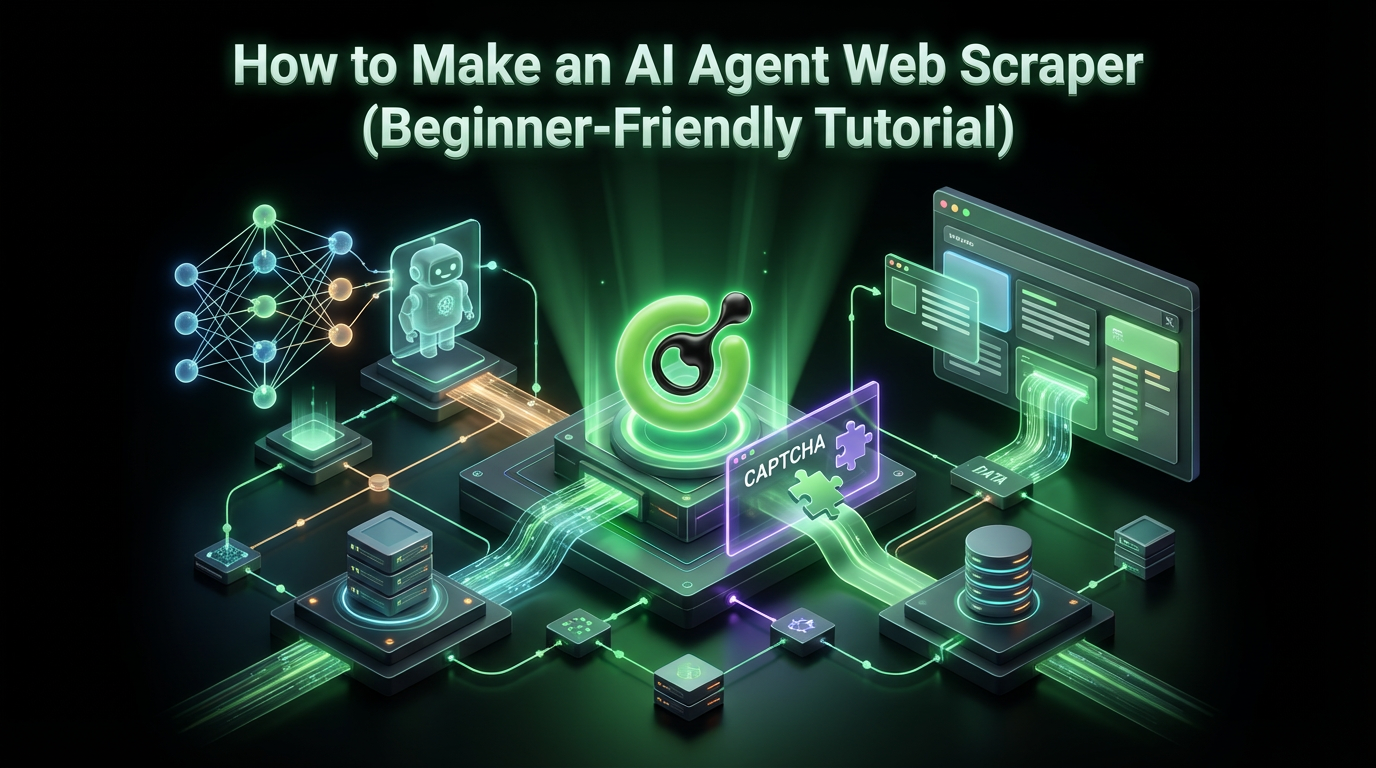
Building an AI Agent Web Scraper is now accessible to beginners, marking a significant evolution from traditional, brittle scraping scripts. This tutorial provides a clear, step-by-step guide to help you create a smart agent that can adapt to website changes and extract data autonomously. You will learn the essential architecture, the necessary tools, and the critical step of overcoming anti-bot defenses. Our goal is to equip you with the knowledge to build a robust and ethical AI Agent Web Scraper that delivers consistent results.
Traditional web scraping relies on static code that targets specific HTML elements, making it prone to breaking when a website updates its layout. AI Agent Web Scrapers, however, use Large Language Models (LLMs) to understand the website's structure and dynamically determine the best extraction strategy. This shift results in a more resilient and intelligent data collection process.
| Feature | Traditional Web Scraper (e.g., BeautifulSoup) | AI Agent Web Scraper (e.g., LangChain/LangGraph) |
|---|---|---|
| Adaptability | Low. Breaks easily with layout changes. | High. Adapts to new layouts and structures. |
| Complexity | Simple for static sites, complex for dynamic. | Higher initial setup, simpler maintenance. |
| Decision Making | None. Follows pre-defined rules. | Dynamic. Uses LLM to decide next action (e.g., click, scroll). |
| Anti-Bot Handling | Requires manual proxy and header management. | Requires integration with specialized services. |
| Best For | Small, static, and predictable data sets. | Large-scale, dynamic, and complex data extraction. |
A successful AI Agent Web Scraper is built on three foundational pillars. Understanding these components is the first step in building an AI Web Scraper for beginners.
The orchestrator is the core logic, typically an LLM or an agent framework like LangChain or LangGraph. It receives a high-level goal (e.g., "Find the price of a product") and breaks it down into executable steps.
This component interacts with the web page, simulating human actions like clicking, typing, and scrolling. It is essential for handling modern, JavaScript-heavy websites.
This is the most critical component for real-world scraping, as websites actively deploy anti-bot measures. The agent must be able to handle IP blocks, rate limits, and, most importantly, CAPTCHAs.
This section guides you through the practical steps of setting up a basic AI Agent Web Scraper. We will focus on the Python ecosystem, which is the standard for this kind of development.
Start by creating a new project directory and installing the necessary libraries. We recommend using a virtual environment to manage dependencies.
# Create a new directory
mkdir ai-scraper-agent
cd ai-scraper-agent

# Install core libraries
pip install langchain seleniumThe agent needs tools to interact with the web. A simple tool is a function that uses Selenium to load a page and return its content.
from selenium import webdriver
from selenium.webdriver.chrome.service import Service
from langchain.tools import tool

# Initialize the WebDriver (ensure you have the correct driver installed)
def get_driver():
    options = webdriver.ChromeOptions()
    options.add_argument('--headless') # Run in background
    options.add_argument('--no-sandbox')
    options.add_argument('--disable-dev-shm-usage')
    # Replace with your actual driver path or use a service that manages it
    service = Service(executable_path='/usr/bin/chromedriver')
    driver = webdriver.Chrome(service=service, options=options)
    return driver

@tool
def browse_website(url: str) -> str:
    """Navigates to a URL and returns the page content."""
    driver = get_driver()
    try:
        driver.get(url)
        # Wait for dynamic content to load
        import time
        time.sleep(3)
        return driver.page_source
    finally:
driver.quit()Use a framework like LangChain to define the agent's behavior. The agent will use the browse_website tool to achieve its goal.
from langchain.agents import AgentExecutor, create_react_agent
from langchain_openai import ChatOpenAI
from langchain_core.prompts import ChatPromptTemplate

# 1. Define the Prompt
prompt = ChatPromptTemplate.from_messages([
    ("system", "You are an expert web scraping agent. Use the available tools to fulfill the user's request."),
    ("human", "{input}"),
    ("placeholder", "{agent_scratchpad}")
])

# 2. Initialize the LLM (Replace with your preferred model)
llm = ChatOpenAI(model="gpt-4o-mini", temperature=0)

# 3. Create the Agent
tools = [browse_website]
agent = create_react_agent(llm, tools, prompt)

# 4. Create the Executor
agent_executor = AgentExecutor(agent=agent, tools=tools, verbose=True)

# Example run
# result = agent_executor.invoke({"input": "What is the main headline on the CapSolver homepage?"})
# print(result)
This setup provides a basic framework for a smart AI Agent Web Scraper. However, as you scale your operations, you will inevitably encounter sophisticated anti-bot challenges.
The primary challenge for any web scraper, especially a high-volume AI Agent Web Scraper, is dealing with anti-bot systems. These systems are designed to detect and block automated traffic, often by presenting CAPTCHAs (Completely Automated Public Turing test to tell Computers and Humans Apart).
According to a recent industry report, over 95% of web scraping request failures are attributed to anti-bot measures like CAPTCHAs and IP bans. This statistic highlights why a robust defense bypass mechanism is non-negotiable for a professional scraping operation.
When your AI Agent Web Scraper encounters a CAPTCHA, it cannot proceed without human intervention—or a specialized service. This is where a high-performance CAPTCHA solver becomes essential.
A modern solver works by receiving the CAPTCHA challenge details (e.g., site key, page URL) and returning a valid token that your agent can use to bypass the challenge and continue scraping. This integration is crucial for maintaining the agent's autonomy.
To ensure your AI Agent Web Scraper remains functional and efficient, we recommend integrating a reliable CAPTCHA solving service. CapSolver is a leading solution that offers high-speed, token-based solving for all major CAPTCHA types, including reCAPTCHA v2/v3,, and Cloudflare challenges.
Why CapSolver is Ideal for AI Agents:
For a detailed guide on integrating this solution into your workflow, read our article on How to Combine AI Browsers With Captcha Solvers.
Once you have the core components, including a reliable defense mechanism, your AI Agent Web Scraper can tackle complex scenarios.
Goal: Extract the top 10 search results and their descriptions from a search engine, even if the layout changes.
browse_website tool, then instructs the LLM to analyze the returned HTML content. The LLM identifies the list items and descriptions based on natural language instructions, not brittle CSS selectors. This is a key advantage of the AI Agent Web Scraper.Goal: Navigate through multiple pages of a product catalog to collect all item names.
click_element(selector)) to simulate the click, then repeats the scraping process. This recursive decision-making is what defines a smart AI Agent Web Scraper.Goal: Scrape a site protected by a Cloudflare anti-bot page.
For more on this, explore our guide on The 2026 Guide to Solving Modern CAPTCHA Systems.
When you build an AI Agent Web Scraper, it is crucial to operate within ethical and legal boundaries. The goal is robust data collection, not confrontation.
robots.txt: Always check and adhere to the website's robots.txt file, which outlines which parts of the site should not be crawled.For further reading on ethical scraping, a detailed resource from the Electronic Frontier Foundation (EFF). discusses the legal landscape of web scraping
The era of the AI Agent Web Scraper is here, offering unprecedented adaptability and efficiency in data collection. By combining an intelligent orchestrator with powerful browser automation and a robust defense bypass mechanism, you can build a scraper that truly works in the real world. This tutorial has provided you with the foundational knowledge and code to start your journey.
To ensure your agent's success against the most challenging anti-bot systems, a reliable CAPTCHA solver is indispensable. Take the next step in building your autonomous AI Agent Web Scraper today.
Start your journey to stable, high-volume data collection by signing up for CapSolver and integrating their powerful API into your agent's workflow.
Redeem Your CapSolver Bonus Code
Boost your automation budget instantly!
Use bonus code CAPN when topping up your CapSolver account to get an extra 5% bonus on every recharge — with no limits.
Redeem it now in your CapSolver Dashboard
.
An AI Agent Web Scraper uses an LLM to make dynamic decisions about navigation and data extraction, adapting to changes. A traditional scraper relies on static, pre-defined rules (like CSS selectors) that break easily when the website changes.
The legality of web scraping is complex and depends on the data being collected and the jurisdiction. Generally, scraping publicly available data is permissible, but you must always respect the website's Terms of Service and avoid scraping private or sensitive information.
Python is the industry standard due to its rich ecosystem of libraries, including LangChain/LangGraph for agent orchestration, Selenium/Playwright for browser automation, and requests for simple HTTP calls.
CapSolver provides an API that your agent can call automatically when it encounters a CAPTCHA challenge. This token-based solution bypasses the anti-bot measure, allowing your AI Agent Web Scraper to continue its task without manual intervention, ensuring high uptime and data flow.
Lucas Mitchell
Automation Engineer
Helping browser automation recover and continue.
ABOUT THE AUTHOR
Learn scalable Rust web scraping architecture with reqwest, scraper, async scraping, headless browser scraping, proxy rotation, and compliant CAPTCHA handling.
Learn the best techniques to scrape job listings without getting blocked. Master Indeed scraping, Google Jobs API, and web scraping API with CapSolver.