🎉NEWCapSolver for AI agents-MCP, agent tools, and SDK integrations

Lola Ng
Key Account Manager
Published Sep 22, 2026
Updated Sep 22, 2026 · min read
A SERP API provider sells search observations to other businesses. Its customers may embed those observations in an SEO platform, combine them into a market report, or request them while a user waits. When a collection step encounters a CAPTCHA, the provider must decide how that interruption affects the customer's delivery.
CapSolver can provide supported CAPTCHA solving within that workflow. The enterprise use case is specific: handle the verification step, retain the customer's query context, and confirm that a usable search observation was produced. The three scenarios below are illustrative service designs, not named customer deployments or measured performance claims.
CAPTCHA solving fits between detecting a supported challenge and validating the search response that follows it.
A CAPTCHA page is not a search-results page, even if the network request completed successfully. If the collector sends that page to an ordinary results parser, the customer could receive a misleading empty result or an incomplete report.
The underlying interruption is real: Google's unusual-traffic guidance describes circumstances in which automated-looking network traffic can lead to a verification message. That documentation is not permission to continue automated collection. The provider must establish a permitted source and collection route before adding any challenge-handling service.
There is also an important purchasing distinction. A company buying a fully managed SERP feed generally needs to evaluate that feed's delivery behavior with its supplier. The separate solver decision belongs to the team operating the permitted browser collection layer. Adding a CAPTCHA service does not turn a raw collector into a complete SERP API.
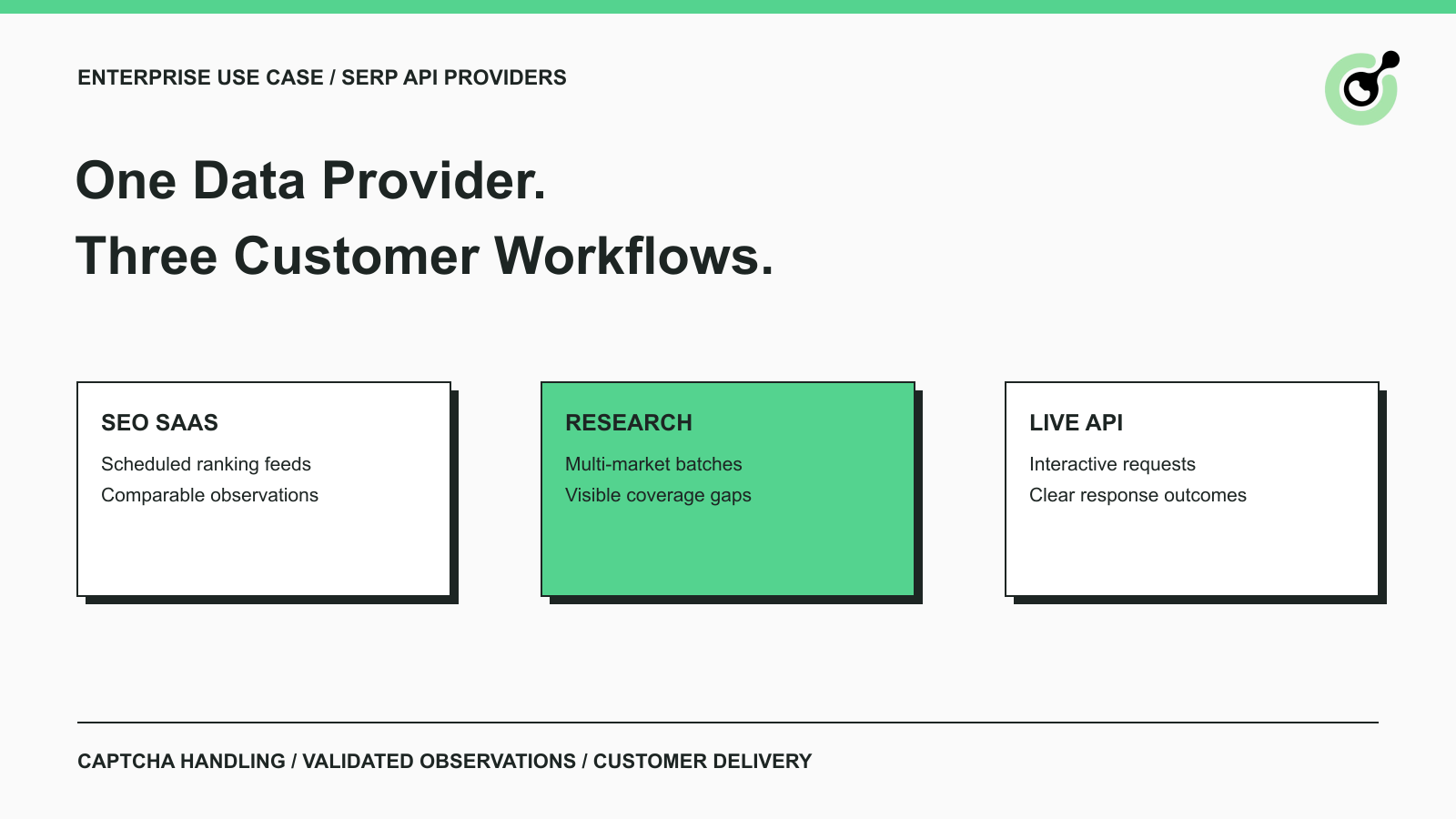
Use the following scenarios to decide what that team needs to protect:
| Enterprise customer workflow | What the provider delivers | What a challenged query puts at risk |
|---|---|---|
| SEO SaaS ranking feed | Comparable observations on an agreed schedule | Freshness and trustworthy rank-change alerts |
| Market-intelligence research batch | An agreed set of query and market observations | Report completeness and comparability |
| Interactive SERP API | A usable response within the product's response window | Customer waiting time and request economics |
A scheduled ranking feed needs comparable observations delivered before the customer's reporting cutoff.
Imagine an SEO software company that refreshes campaign dashboards each morning. Its SERP supplier receives a defined set of keywords, locations, languages, and device settings. A verification interruption in one subset of those requests should remain visible as a collection issue; it should not become a claim that the monitored website disappeared from search.
The supplier can place supported CAPTCHA handling inside the affected collection job. If the step completes and the requested search response is available, the supplier validates that response and includes the observation in the delivery. If the job remains unresolved, the supplier reports the missing observation according to the feed contract.
Query context matters because the customer compares observations over time. Google's explanation of search relevance describes how location, language, and region can affect results. A completed observation for a different location is therefore not an interchangeable replacement for the requested one.
Keep the customer campaign, original query settings, and collection time attached to the job throughout challenge handling. A solver task ID can identify the verification operation, but it should not replace the supplier's query identifier.
The customer-facing response should distinguish the latest accepted observation from today's unsuccessful attempt. If the product displays an older result, show its actual observation time. A stale value presented as a fresh ranking can generate a false alert even though the underlying data was once correct.
For this workflow, the useful acceptance measure is the proportion of expected observations delivered and validated by the agreed cutoff. Solver-result rate is a diagnostic input to that measure.
A research batch needs clear coverage across the query groups and markets the customer commissioned.
Consider a market-intelligence platform comparing public search visibility for a set of product categories. It orders observations across several markets for a report. If one market has more unresolved collection jobs, a report built from the remaining data could appear to show a commercial difference that actually reflects uneven coverage.
The provider should keep challenged jobs identifiable within the original batch. Supported challenge handling can give an eligible job a path to completion, while the batch report still records which observations were accepted, missing, or collected outside the intended window.
Agree in advance whether the customer wants a complete batch or accepts partial results with a coverage report. A partial delivery can be useful when its limits are visible; silently dropping unresolved rows changes the meaning of the dataset.
For example, the provider might deliver completed categories while marking one market as incomplete. The customer can then postpone that comparison instead of interpreting fewer collected observations as weaker brand visibility. This is a proposed reporting policy, not a claim about an actual client's process.
After challenge handling, check the query identity and requested result categories before accepting the observation. A parser that expects organic results should not treat an unfamiliar response as an empty organic list. The existing SERP production-readiness checklist covers those validation and storage checks in more detail.
Keep internal reruns separate from customer deliverables. Multiple attempts to complete one observation should not produce duplicate rows or inflate the delivered query count. Decide how a corrected delivery replaces an earlier partial version, and make that revision understandable to the customer.
For this scenario, evaluate accepted coverage by market and query group, alongside the collection window. A single overall completion percentage can hide the exact gap that matters to the report.
Redeem Your CapSolver Bonus Code
Boost your automation budget instantly!
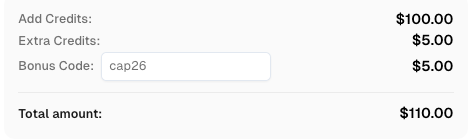
Use bonus code CAP26 when topping up your CapSolver account to get an extra 5% bonus on every recharge — with no limits.
Redeem it now in your CapSolver Dashboard
An interactive SERP API needs a defined response window and an explicit outcome when a query cannot finish within it.
In this scenario, an enterprise customer embeds search data in a research interface. A user requests a current observation, and the customer's application waits for the supplier's API. A supported CAPTCHA may add work before the supplier can return validated data.
The provider should decide how that work fits the endpoint's delivery contract. A synchronous endpoint might have a bounded completion window. A separate asynchronous product could acknowledge a job and expose its eventual status. These are product-design choices; do not switch a customer's expected response behavior silently when a challenge appears.
Before beginning additional work, check whether the query remains active and whether the remaining delivery window can accommodate the configured handling path. When the customer has cancelled a request, reconcile work already submitted rather than assuming that a local cancellation stopped a remote service task.
If fresh data is unavailable, return the documented pending or failure outcome. Cached data is suitable only when the product permits it and identifies its age. A cached response must not be labelled as a newly observed SERP simply because the API returned it now.
Google's service-level objectives guidance distinguishes measured service behavior, targets, and contractual commitments. For a SERP provider, customer-visible completion time and usable response rate are more relevant acceptance criteria than the duration of the solver call alone.
No universal solving speed makes every interactive request viable. Trial the complete path under your own operating conditions before offering a response-time commitment.
Use CapSolver for the supported verification task while your service retains responsibility for search collection and delivery.
The practical sequence is straightforward:
The solver does not select your customer's locale, assign organic rankings, decide cache freshness, or generate a complete report. Keeping those responsibilities in the SERP service makes failures easier to explain.
Evaluate commercial fit with a small, representative trial covering the delivery mode you actually sell.
Choose a permitted query set, state the observation requirements, and set the customer's acceptance rule before collecting results. Include ordinary successful queries and observed challenge cases. If the trial encounters no CAPTCHA, it can test the surrounding delivery path but cannot establish live solver performance for that workload.
Review four outcomes together: usable observations delivered, delivery windows met, unresolved jobs requiring attention, and total cost per accepted observation. Include unsuccessful handling attempts in costs. Consult CapSolver's current task pricing and actual usage records rather than treating an advertised per-task rate as the complete cost of a customer result.
Break the review down by delivery product and customer workload. A research batch and an interactive endpoint may have different acceptable timing even when they use the same solver. Separate queue and spend limits can also prevent one customer's unresolved jobs from consuming the entire team's operating budget.
Agree on which conditions suspend further work and which owner reviews them. Repeated verification, source refusal, or unexplained response changes should trigger investigation. Increasing retries is not a substitute for a valid collection route.
The strongest enterprise use case connects CAPTCHA handling to a specific delivery promise.
For an SEO SaaS feed, protect comparable scheduled observations. For a market-intelligence batch, protect coverage and explain partial delivery. For an interactive API, protect the response contract and show when fresh data is unavailable.
Use CapSolver where its documented challenge handling fits that permitted workflow, then measure the search-data outcome your customer actually receives.
Q: Why would a SERP API provider use a CAPTCHA solver?
A provider operating a permitted browser collection layer may encounter supported CAPTCHA challenges before it can obtain a search response. A solver handles that verification task while the provider remains responsible for collection, validation, and delivery.
Q: Is CapSolver itself a SERP data API?
The CapSolver interfaces discussed here create and retrieve CAPTCHA task results. They do not return a ready-made SERP dataset, keyword rankings, or a customer research report.
Q: Does a company buying a managed SERP feed need its own solver?
Not necessarily. If the supplier operates the collection layer, discuss challenge handling and incomplete deliveries with that supplier. A separate solver is relevant to the team responsible for the underlying permitted collection workflow.
Q: What should happen when a challenged query misses the delivery deadline?
Return the outcome defined by the product: a missing observation, a partial batch, a pending job, or a failure. Do not silently turn the interrupted query into an empty search result or present old data as fresh.
Q: What should an enterprise pilot measure?
Measure accepted observations, deadline compliance, unresolved work, and total cost per accepted result. Review those outcomes by customer workload and delivery mode; a returned solver token alone does not establish successful SERP delivery.
Lola Ng
Key Account Manager
Connecting customer needs with practical automation solutions.
ABOUT THE AUTHOR
Learn scalable Rust web scraping architecture with reqwest, scraper, async scraping, headless browser scraping, proxy rotation, and compliant CAPTCHA handling.

Learn the best techniques to scrape job listings without getting blocked. Master Indeed scraping, Google Jobs API, and web scraping API with CapSolver.