
🎉NEWCapSolver for AI agents-MCP, agent tools, and SDK integrations

Emma Foster
Machine Learning Engineer
Published Jan 08, 2026
Updated Jan 09, 2026 · min read
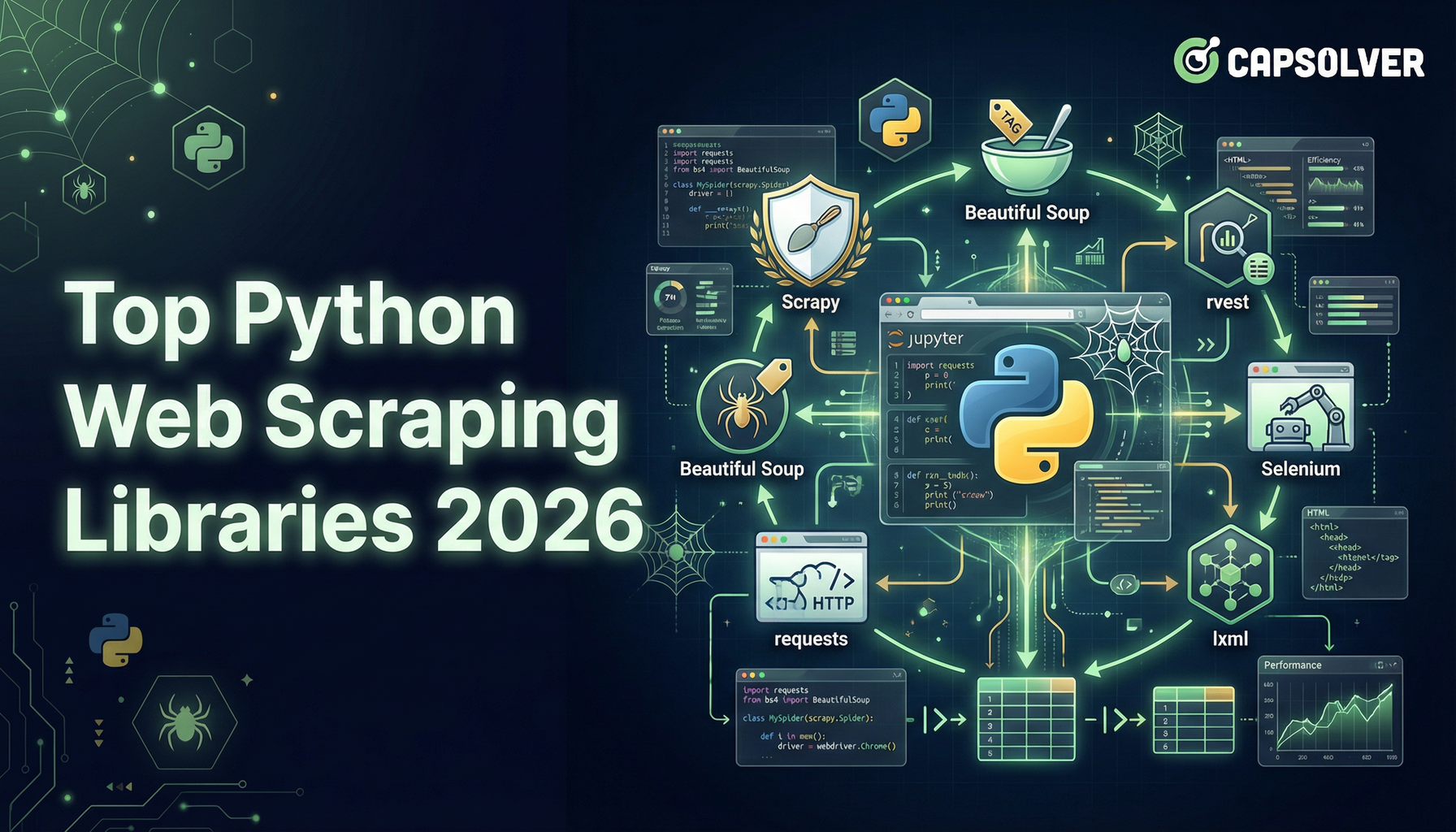
robots.txt and website terms of service, are paramount.Did you know that the global data analytics market is projected to reach $655.8 billion by 2029, growing at a CAGR of 12.9%? (Source: Grand View Research). This explosive growth underscores the increasing importance of data extraction, and Python web scraping remains a cornerstone for accessing and analyzing vast amounts of online information. As we look ahead to 2026, the landscape of Python web scraping libraries continues to evolve, offering developers increasingly powerful, efficient, and user-friendly tools.
Choosing the right library can significantly impact the success of your scraping projects, affecting everything from development time to the robustness of your scrapers. This guide will delve into the leading Python web scraping libraries you should consider in 2026, examining their strengths, weaknesses, and ideal use cases. We'll cover everything from beginner-friendly options to advanced frameworks, ensuring you have the knowledge to select the perfect tool for your data extraction needs.
Python's dominance in web scraping isn't accidental. Several key factors contribute to its popularity:
Before diving into specific libraries, it's crucial to understand the factors that differentiate them:
How quickly can you get started? Libraries with simpler APIs and clear documentation are ideal for beginners or projects with tight deadlines. For complex projects requiring intricate logic, a more feature-rich but potentially steeper learning curve might be acceptable.
Does the library handle dynamic content (JavaScript-rendered pages)? Does it support handling CAPTCHAs or proxies? Does it offer asynchronous capabilities for faster scraping? The features you need will depend heavily on the websites you intend to scrape.
For large-scale scraping operations, performance is paramount. Libraries that can handle many requests concurrently or efficiently process large amounts of data will be more suitable. Asynchronous programming and efficient memory management are key here.
Good documentation and an active community are invaluable. They provide help when you're stuck and ensure the library is maintained and updated.
Many websites employ measures to block scrapers. Your chosen library should ideally offer features or integrate well with tools that can help bypass these restrictions, such as proxy rotation, user-agent spoofing, and CAPTCHA solving services.
Let's explore the leading contenders that are set to dominate the web scraping scene in 2026.
Beautiful Soup is arguably the most popular and widely used Python library for parsing HTML and XML documents. It creates a parsing tree from page source code that can be used to extract data in a hierarchical and readable way.
requests for fetching web pages.Example (using requests):
import requests
from bs4 import BeautifulSoup

url = 'http://example.com'
response = requests.get(url)
soup = BeautifulSoup(response.text, 'html.parser')

# Find all paragraph tags
paragraphs = soup.find_all('p')
for p in paragraphs:
print(p.text)Scrapy is a powerful, open-source web crawling framework. It's designed for large-scale scraping projects, offering a comprehensive suite of tools for fetching, processing, and storing data. Scrapy operates on a component-based architecture, allowing for flexibility and extensibility.
Official Scrapy Documentation: Scrapy Project
Selenium is primarily known as a tool for automating web browsers for testing purposes. However, its ability to control a real browser instance makes it incredibly powerful for web scraping, especially when dealing with JavaScript-heavy websites.
Requests-HTML is a library that aims to provide a more user-friendly experience for web scraping, combining the ease of requests with some of the parsing capabilities of Beautiful Soup and the ability to render JavaScript.
Developed by Microsoft, Playwright is a newer but rapidly growing automation library that enables reliable end-to-end testing and web scraping. It offers a robust API for controlling Chromium, Firefox, and WebKit browsers.
Playwright Documentation: Playwright
Puppeteer is a Node.js library developed by Google for controlling Chrome or Chromium. The pyppeteer library is a Python port that allows you to use Puppeteer's capabilities within Python.
pyppeteer is a third-party port and might not always be as up-to-date or stable as the original Node.js library.Beyond the core libraries, several advanced techniques and tools can enhance your scraping capabilities:
CAPTCHAs are designed to prevent automated access. For legitimate scraping needs (e.g., market research), you might need to solve them. Services like CapSolver offer APIs that can solve various types of CAPTCHAs programmatically. Integrating these services with your scrapers can significantly improve success rates on sites that employ such measures.
To avoid IP bans and distribute your requests, using proxies is essential for large-scale scraping. Libraries like requests and Scrapy support proxy usage. You can use rotating proxy services to manage a pool of IP addresses.
Websites often check the User-Agent header to identify bots. Rotating through a list of common browser user agents can help your scraper appear more like a legitimate user.
Respecting website terms of service and avoiding overwhelming servers is crucial. Implementing delays (time.sleep() in Python) between requests or using Scrapy's built-in rate limiting features is good practice.
As discussed with Selenium, Playwright, and Puppeteer, headless browsers (browsers running without a graphical interface) are essential for scraping dynamic content. They execute JavaScript and render pages just like a regular browser.
Here’s a quick decision tree to help you select the best library:
requests.While powerful, web scraping comes with ethical responsibilities. Always:
robots.txt: This file on a website indicates which parts of the site bots are allowed or disallowed to access.According to a study by the University of Washington, responsible scraping practices are crucial for maintaining access to public data and avoiding legal repercussions. (Source: University of Washington, Computer Science & Engineering).
As we move into 2026, the Python web scraping ecosystem continues to offer a diverse range of powerful tools. Whether you're a beginner looking to extract data from simple static pages or an experienced developer tackling complex, dynamic websites, there's a Python library suited for your needs. Beautiful Soup remains the go-to for simplicity, Scrapy for large-scale projects, and Selenium, Playwright, and Requests-HTML are indispensable for handling dynamic content. By understanding the strengths and weaknesses of each, and by scraping responsibly, you can effectively harness the power of web scraping to gather valuable data.
A1: For beginners, Beautiful Soup combined with the requests library is generally considered the easiest to learn and use. It has a straightforward API for parsing HTML and XML documents.
A2: Libraries that can control a web browser are best for JavaScript-heavy sites. Selenium, Playwright, and Requests-HTML (with its JavaScript rendering capabilities) are excellent choices. Playwright is often praised for its speed and reliability.
A3: While Python libraries are very powerful, you must always check a website's robots.txt file and its Terms of Service. Some websites prohibit scraping, and attempting to scrape them can lead to legal issues or IP bans. Furthermore, some sites use advanced anti-scraping techniques that can be difficult to overcome.
A4: CAPTCHAs are designed to stop automated scripts. For legitimate scraping needs, you can integrate with third-party CAPTCHA solving services like CapSolver. These services provide APIs that can solve various CAPTCHA types programmatically, allowing your scraper to proceed.
A5: While Scrapy is incredibly powerful and scalable, it might be overkill for very simple scraping tasks. For basic extraction from a few static pages, Beautiful Soup and requests would be more efficient to set up and run.
A6: Key ethical guidelines include: always check and respect robots.txt, adhere to website Terms of Service, avoid overwhelming the website's servers with too many requests (implement delays), and never scrape private or sensitive user data without explicit consent. Responsible scraping ensures the continued availability of online data.
Emma Foster
Machine Learning Engineer
Where machine learning meets practical AI tooling.
ABOUT THE AUTHOR
Learn scalable Rust web scraping architecture with reqwest, scraper, async scraping, headless browser scraping, proxy rotation, and compliant CAPTCHA handling.

Learn the best techniques to scrape job listings without getting blocked. Master Indeed scraping, Google Jobs API, and web scraping API with CapSolver.