
🎉NEWCapSolver for AI agents-MCP, agent tools, and SDK integrations

Rajinder Singh
Deep Learning Researcher
Published Dec 28, 2023
Updated Dec 28, 2023 · min read
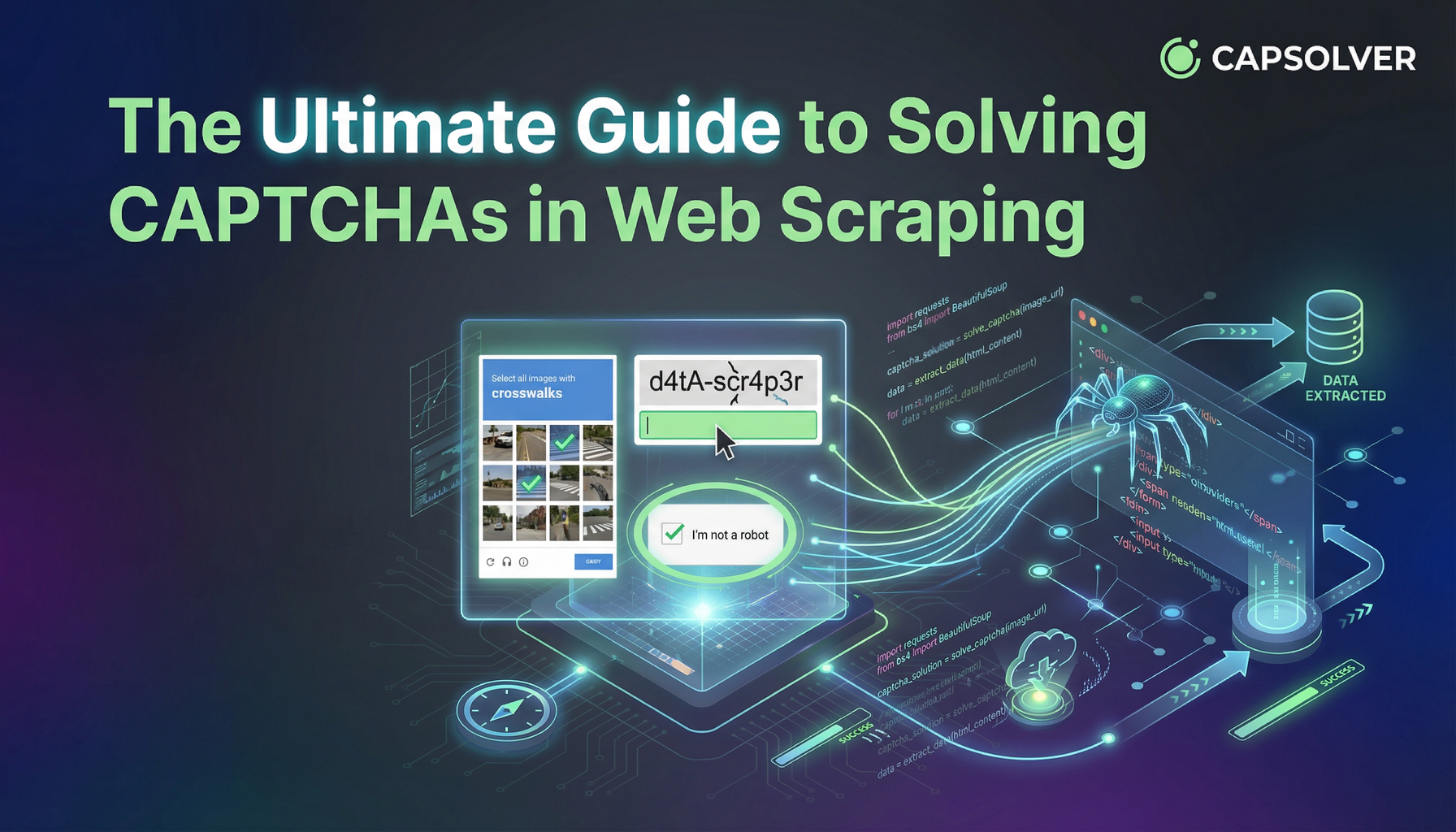
CAPTCHAs are designed to distinguish humans from automated programs, but they frequently interrupt web scraping workflows. This guide explains what CAPTCHAs are, why websites use them, how they function, and why they pose challenges for data extraction. It also outlines practical approaches—such as CAPTCHA-solving services, machine learning with OCR, CAPTCHA farms, and APIs—to help web scrapers handle CAPTCHA interruptions more efficiently and maintain stable data collection processes.
Web scraping has become an essential tool for extracting data from websites. However, the presence of CAPTCHAs poses a significant challenge for web scrapers. In this comprehensive guide, we will delve into the world of CAPTCHAs, exploring what they are, why they are used, how they work, and most importantly, techniques and tips for effectively solving CAPTCHAs during web scraping. Whether you're an experienced web data collector or a novice, mastering the art of overcoming CAPTCHAs is vital for optimizing the process of gathering and analyzing web data effectively.
CAPTCHA, an acronym for "Completely Automated Public Turing test to Tell Computers and Humans Apart," is a security measure designed to differentiate between human users and automated bots. Two groups working simultaneously invented a widely used type of CAPTCHA in 1997, marking a significant milestone in its history. This type of CAPTCHA utilizes a distorted image where users need to enter a sequence of letters or numbers. Unlike the traditional Turing test conducted by humans, CAPTCHAs are computer-administered tests, leading them to be referred to as reverse Turing tests. Development to date, it presents users with challenges, such as distorted text, images, or puzzles, and requires them to provide correct responses to prove their authenticity.
CAPTCHAs are utilized as a defense mechanism against various malicious activities, including spamming, data scraping, account creation, and brute-force attacks. Their implementation aims to authenticate the legitimacy of users, allowing genuine human access while deterring automated bots.
However, as technology advances, the emergence of captcha solvers presents a challenge. These automated systems are designed to solve CAPTCHAs, solveing the intended security measures. They employ image recognition, text analysis, and machine learning algorithms to quickly and accurately solve CAPTCHAs, compromising their effectiveness.
To counteract this, captcha solving services have emerged, offering specialized solutions for web scraping. These services employ advanced algorithms and techniques to overcome CAPTCHAs during web scraping operations, enabling automated extraction of desired data.
CAPTCHAs employ various methods to challenge bots and verify human users. These methods include image recognition, audio challenges, logical puzzles, and even behavior analysis. By presenting tasks that are difficult for machines to solve but relatively easier for humans, CAPTCHAs create a barrier that bots find challenging to overcome. Two widely used CAPTCHA services are cloudflare, an independent company, and reCAPTCHA, offered by Google. It takes the average person approximately 10 seconds to solve a typical CAPTCHA.
CAPTCHAs pose a significant obstacle for web scrapers as their primary purpose is to prevent automated bots from accessing and interacting with websites. When encountered during scraping, a web page containing a CAPTCHA test blocks bots and scripts from accessing the desired site's content and extracting data. This interruption halts the scraping process.
Even after gaining access to the target site, a background test continually monitors user activities and behaviors. Any signs of rapid clicks or unusually high pageviews may trigger suspicion from the website, leading to the requirement of a CAPTCHA verification test.
While certain types of CAPTCHAs, like image-based or audio-based ones, can be solved by some web scrapers, more complex forms such as interactive CAPTCHAs or "No CAPTCHA" reCAPTCHA present challenges even for real individuals.
Redeem Your CapSolver Bonus Code
Boost your automation budget instantly!
Use bonus code CAPN when topping up your CapSolver account to get an extra 5% bonus on every recharge — with no limits.
Redeem it now in your CapSolver Dashboard
.
CAPTCHAs present a significant challenge for web scrapers, often requiring manual intervention and disrupting the automated data extraction process. However, by employing various techniques such as CAPTCHA-solving services, machine learning and OCR, CAPTCHA farms, and anti-CAPTCHA libraries, web scrapers can overcome these obstacles and ensure smoother scraping operations. It is essential to choose the most suitable approach based on the specific requirements and constraints of your scraping project. By mastering the art of solving CAPTCHAs, web scrapers can unlock a wealth of valuable data while maintaining respect for website owners' security measures.
CAPTCHAs are specifically implemented to detect and restrict automated behavior. When a scraper generates patterns such as rapid requests, high page views, or non-human interactions, websites may trigger CAPTCHA challenges to prevent automated data access and protect their resources.
For most scraping projects, using a dedicated CAPTCHA-solving service is the most efficient option. These services can automatically handle multiple CAPTCHA types and reduce manual intervention, allowing scraping workflows to continue with minimal disruption compared to building custom machine learning solutions from scratch.
Machine learning and OCR can solve certain CAPTCHA types, particularly text- or image-based challenges, but they require substantial training data, ongoing maintenance, and technical expertise. In many real-world scenarios, combining automated services with other techniques offers better reliability and scalability for long-term scraping operations.
Rajinder Singh
Deep Learning Researcher
Making CAPTCHA solving more reliable in automated workflows.
ABOUT THE AUTHOR
Explore how AI detects and solves CAPTCHA challenges, from image recognition to behavioral analysis. Understand the technology behind AI CAPTCHA solvers and how CapSolver aids automated workflows. Learn about the evolving battle between AI and human verification.

Compare top CAPTCHA solving APIs by speed, accuracy, uptime, and pricing. See how CapSolver, 2Captcha, CapMonster Cloud, and others stack up in our detailed performance comparison.

Master how to integrate CAPTCHA solving API in Python with this step-by-step guide. Learn to automate reCAPTCHA, Geetest, and AWS WAF using CapSolver for reliable data extraction.
Discover how an Image Recognition API for custom CAPTCHAs streamlines automation. Learn about AI vision logic, OCR vs. AI, and CapSolver's modular solutions.