🎉NEWCapSolver for AI agents-MCP, agent tools, and SDK integrations

Ethan Collins
AI Agent Workflow Engineer
Published Nov 29, 2023
Updated Nov 25, 2025 · min read
Key Takeaways
AI search automation and web scraping, tools like Puppeteer have become indispensable for controlling headless browsers and simulating human interaction. However, as automation scales, so does the sophistication of anti-bot measures. One of the most formidable challenges today is the AWS WAF CAPTCHA, which frequently interrupts large-scale data collection, leading to task failure and wasted resources.
This article provides a targeted, technical guide for Javascript developers using Puppeteer. We will demonstrate a highly effective best practice: integrating the CapSolver Extension directly into your Puppeteer setup. This approach allows the extension to handle the complex, AI-driven CAPTCHA solving process for AWS WAF challenges seamlessly. Additionally, for scenarios requiring a purely headless, API-driven approach, we will provide a detailed Javascript example using the CapSolver API, ensuring your AI search automation remains stable, uninterrupted, and highly successful.
The AWS WAF CAPTCHA is a robust security layer that goes beyond simple image recognition. It often involves:
aws-waf-token to be present in subsequent requests, which is generated only after the challenge is successfully solved.For large-scale AI search automation, manually handling these challenges is impractical. This is where specialized CAPTCHA solving tools, particularly those integrated directly into the browser environment or via API, become a crucial best practice.
The CapSolver Extension acts as a bridge, automatically detecting and solving CAPTCHA challenges encountered by the browser and injecting the required solution token. This is a far simpler and more robust method for browser automation than using the API directly in your Puppeteer script.
Before integrating with Puppeteer, you need the extension files and your API key configured.
./capsolver-extension).config.js or similar) and insert your CapSolver API key. This authenticates the extension with your account.Puppeteer's puppeteer.launch() function provides an option to load unpacked extensions using the args parameter.
const puppeteer = require('puppeteer');
const path = require('path');

// Define the path to your extracted CapSolver Extension folder
const extensionPath = path.join(__dirname, 'capsolver-extension');

async function launchBrowserWithExtension() {
    const browser = await puppeteer.launch({
        headless: false, // Must be non-headless for the extension to work reliably
        args: [
            `--disable-extensions-except=${extensionPath}`,
            `--load-extension=${extensionPath}`,
            '--no-sandbox', // Recommended for some environments
        ],
    });
    return browser;
}

// Example usage:
// const browser = await launchBrowserWithExtension();
// const page = await browser.newPage();
// await page.goto('https://your-aws-waf-protected-site.com');Once the browser is launched with the CapSolver Extension, the automation flow becomes significantly simpler. The extension automatically monitors the page. If an AWS WAF CAPTCHA is detected, the extension takes over, solves it using the CapSolver service, and the page automatically reloads or proceeds.
The core of your AI search automation script simply needs to navigate to the target page and wait for the CAPTCHA to be resolved.
const puppeteer = require('puppeteer');
const path = require('path');

// ... (launchBrowserWithExtension function from Step 2) ...

async function runAwsWafAutomation() {
    const browser = await launchBrowserWithExtension();
    const page = await browser.newPage();

    // 1. Navigate to the AWS WAF protected URL
    const targetUrl = 'https://efw47fpad9.execute-api.us-east-1.amazonaws.com/latest'; // Example URL
    console.log(`Navigating to ${targetUrl}...`);
    await page.goto(targetUrl, { waitUntil: 'domcontentloaded' });

    // 2. Wait for the CAPTCHA to be solved
    // The CapSolver Extension will automatically detect and solve the AWS WAF CAPTCHA.

    // BEST PRACTICE: Wait for the absence of the CAPTCHA element or the presence of the target content.
    try {
        // Assuming the CAPTCHA has a specific selector, e.g., '#aws-waf-captcha-container'
        // We wait for this element to disappear (i.e., the CAPTCHA is solved and the page proceeds)
        console.log("Waiting for AWS WAF CAPTCHA to be solved by CapSolver Extension...");
        await page.waitForSelector('#aws-waf-captcha-container', { hidden: true, timeout: 60000 });
        console.log("CAPTCHA solved! Proceeding with AI search automation.");

        // 3. Continue with your AI search automation logic
        // Example: Extracting data from the now-accessible page
        const pageTitle = await page.title();
        console.log(`Page Title (Post-CAPTCHA): ${pageTitle}`);

    } catch (error) {
        console.error("CAPTCHA solving timed out or failed:", error.message);
    }

    await browser.close();
}

// runAwsWafAutomation();For developers who prefer a purely headless environment or need to integrate the CAPTCHA solving logic into a non-browser-based application, the CapSolver API offers a robust alternative. This method requires you to manually extract the necessary AWS WAF parameters (awsKey, awsIv, awsContext, etc.) from the blocked page and pass them to the API.
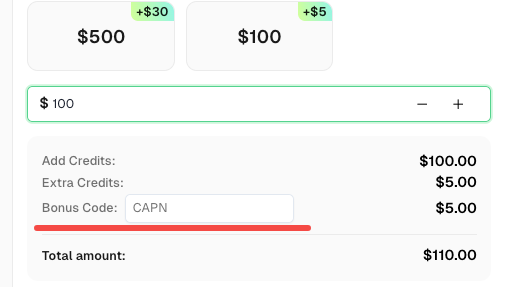
Redeem Your CapSolver Bonus Code
Don’t miss the chance to further optimize your operations! Use the bonus code CAPN when topping up your CapSolver account and receive an extra 5% bonus on each recharge, with no limits. Visit the CapSolver to redeem your bonus now!
This example uses the standard fetch API (available in modern Node.js) to communicate with CapSolver, based on the task structure provided in the CapSolver documentation.
const fetch = require('node-fetch'); // Use 'node-fetch' for older Node.js versions, or native fetch for newer versions

const CAPSOLVER_API_KEY = 'YOUR_CAPSOLVER_API_KEY';
const API_URL = 'https://api.capsolver.com';

/**
 * Solves the AWS WAF CAPTCHA using the CapSolver API.
 * @param {string} websiteURL The URL of the page showing the CAPTCHA.
 * @param {object} awsParams The parameters extracted from the blocked page (awsKey, awsIv, awsContext, etc.).
 * @returns {Promise<string>} The aws-waf-token cookie value.
 */
async function solveAwsWafCaptcha(websiteURL, awsParams) {
    // 1. Create the task
    const createTaskPayload = {
        clientKey: CAPSOLVER_API_KEY,
        task: {
            type: "AntiAwsWafTaskProxyLess", // Use AntiAwsWafTask if you need to specify a proxy
            websiteURL: websiteURL,
            ...awsParams // Pass extracted parameters
        }
    };

    let response = await fetch(`${API_URL}/createTask`, {
        method: 'POST',
        headers: { 'Content-Type': 'application/json' },
        body: JSON.stringify(createTaskPayload)
    });
    let result = await response.json();

    if (result.errorId !== 0) {
        throw new Error(`CapSolver API Error (createTask): ${result.errorDescription}`);
    }

    const taskId = result.taskId;
    console.log(`Task created with ID: ${taskId}. Waiting for result...`);

    // 2. Poll for the result
    const getResultPayload = {
        clientKey: CAPSOLVER_API_KEY,
        taskId: taskId
    };

    let solution = null;
    for (let i = 0; i < 15; i++) { // Poll up to 15 times (max 30 seconds)
        await new Promise(resolve => setTimeout(resolve, 2000)); // Wait 2 seconds

        response = await fetch(`${API_URL}/getTaskResult`, {
            method: 'POST',
            headers: { 'Content-Type': 'application/json' },
            body: JSON.stringify(getResultPayload)
        });
        result = await response.json();

        if (result.errorId !== 0) {
            throw new Error(`CapSolver API Error (getTaskResult): ${result.errorDescription}`);
        }

        if (result.status === 'ready') {
            solution = result.solution;
            break;
        }
        console.log(`Status: ${result.status}. Retrying...`);
    }

    if (!solution || !solution.cookie) {
        throw new Error("CapSolver failed to return a valid token within the timeout.");
    }

    // The solution.cookie contains the aws-waf-token
    return solution.cookie;
}

// Example usage in a headless Puppeteer script:
/*
async function runHeadlessApiAutomation() {
    // 1. Use Puppeteer to navigate and extract AWS WAF parameters (e.g., from a script tag or network response)
    // This step requires advanced Puppeteer skills to intercept network requests or parse the HTML source.
    const websiteURL = 'https://efw47fpad9.execute-api.us-east-1.amazonaws.com/latest';
    const extractedAwsParams = {
        awsKey: "AQIDAHjcYu/GjX+QlghicBg......",
        awsIv: "CgAAFDIlckAAAAid",
        awsContext: "7DhQfG5CmoY90ZdxdHCi8WtJ3z......",
        // ... other optional parameters
    };

    try {
        const awsWafToken = await solveAwsWafCaptcha(websiteURL, extractedAwsParams);
        console.log(`Successfully obtained AWS WAF Token: ${awsWafToken.substring(0, 30)}...`);

        // 2. Inject the token back into the Puppeteer session or use it in a subsequent request header/cookie
        // Example: Injecting as a cookie for the next request
        // await page.setCookie({
        //     name: 'aws-waf-token',
        //     value: awsWafToken,
        //     domain: new URL(websiteURL).hostname,
        //     path: '/',
        // });
        // await page.reload({ waitUntil: 'networkidle0' });

    } catch (error) {
        console.error("API Automation Failed:", error.message);
    }
}
*/While CAPTCHA solving is critical, a successful AI search automation system requires a multi-layered approach.
| Best Practice | Description | Relevance to Puppeteer/JS |
|---|---|---|
| Stealth Mode | Use libraries like puppeteer-extra with the puppeteer-extra-plugin-stealth to hide the tell-tale signs of automation. |
Essential for passing initial bot checks before the AWS WAF CAPTCHA is even presented. |
| IP Rotation | Integrate a proxy service to rotate IP addresses, preventing rate-limiting and IP bans. | Use the --proxy-server argument in puppeteer.launch() to route traffic through a high-quality residential proxy. |
| Human-like Delays | Implement random, non-linear delays between actions (e.g., typing, clicking, scrolling). | Use page.waitForTimeout(Math.random() * 3000 + 1000) to introduce random delays between 1 and 4 seconds. |
| Session Management | Persist cookies and local storage across sessions to maintain a consistent user profile. | Use the userDataDir option in puppeteer.launch() to save and reuse browser profiles. |
The combination of Puppeteer's robust browser control and the CapSolver Extension's specialized CAPTCHA solving capabilities offers a definitive solution to the challenge of AWS WAF CAPTCHA in AI search automation. For pure headless environments, the CapSolver API provides the necessary power and flexibility. By adopting these best practice methods, developers can ensure their data collection pipelines are resilient, efficient, and maintain a high success rate.
Ready to boost your automation success rate? Stop letting CAPTCHA blocks interrupt your workflow. Click here to learn more about the CapSolver Extension and its powerful AWS WAF solving capabilities, and start your free trial today!
While the CapSolver API is highly effective, using the Extension simplifies the code significantly. The Extension operates within the browser context, automatically detecting the CAPTCHA, solving it, and injecting the necessary token/cookie (aws-waf-token) without requiring your main Puppeteer script to manage the complex API request/response cycle. This is a key best practice for clean, maintainable browser automation code.
For the CapSolver Extension to function reliably, especially for complex behavioral challenges like AWS WAF CAPTCHA, it is generally recommended to run Puppeteer in non-headless mode (headless: false). This ensures the full browser environment, including the extension's background scripts and visual components, is active to handle the challenge.
AWS WAF CAPTCHA is typically a more direct, hard-block challenge implemented by Amazon's Web Application Firewall, often requiring a token to proceed. reCAPTCHA v3, on the other hand, is a score-based system that runs silently in the background. However, both rely heavily on behavioral analysis, making the use of stealth techniques and specialized CAPTCHA solving services a necessary best practice for both.
Beyond using the CapSolver Extension for CAPTCHA solving, you must implement AI search automation best practices such as:
puppeteer-extra with stealth plugins.userDataDir).You can find detailed guides and code examples on the CapSolver blog:
Ethan Collins
AI Agent Workflow Engineer
Building clearer handoffs between AI agents and tools.
ABOUT THE AUTHOR
Learn how to set up a browser extension for automatic CAPTCHA solving. Boost your web automation efficiency with step-by-step instructions and code examples.

Discover the best CAPTCHA solver Chrome extension in 2026. Compare top tools like CapSolver and AZcaptcha for speed, accuracy, and AI-powered bypass of reCAPTCHA and Cloudflare.