
🎉NEWCapSolver for AI agents-MCP, agent tools, and SDK integrations

Lucas Mitchell
Automation Engineer
Published Apr 23, 2026
Updated Apr 23, 2026 · min read
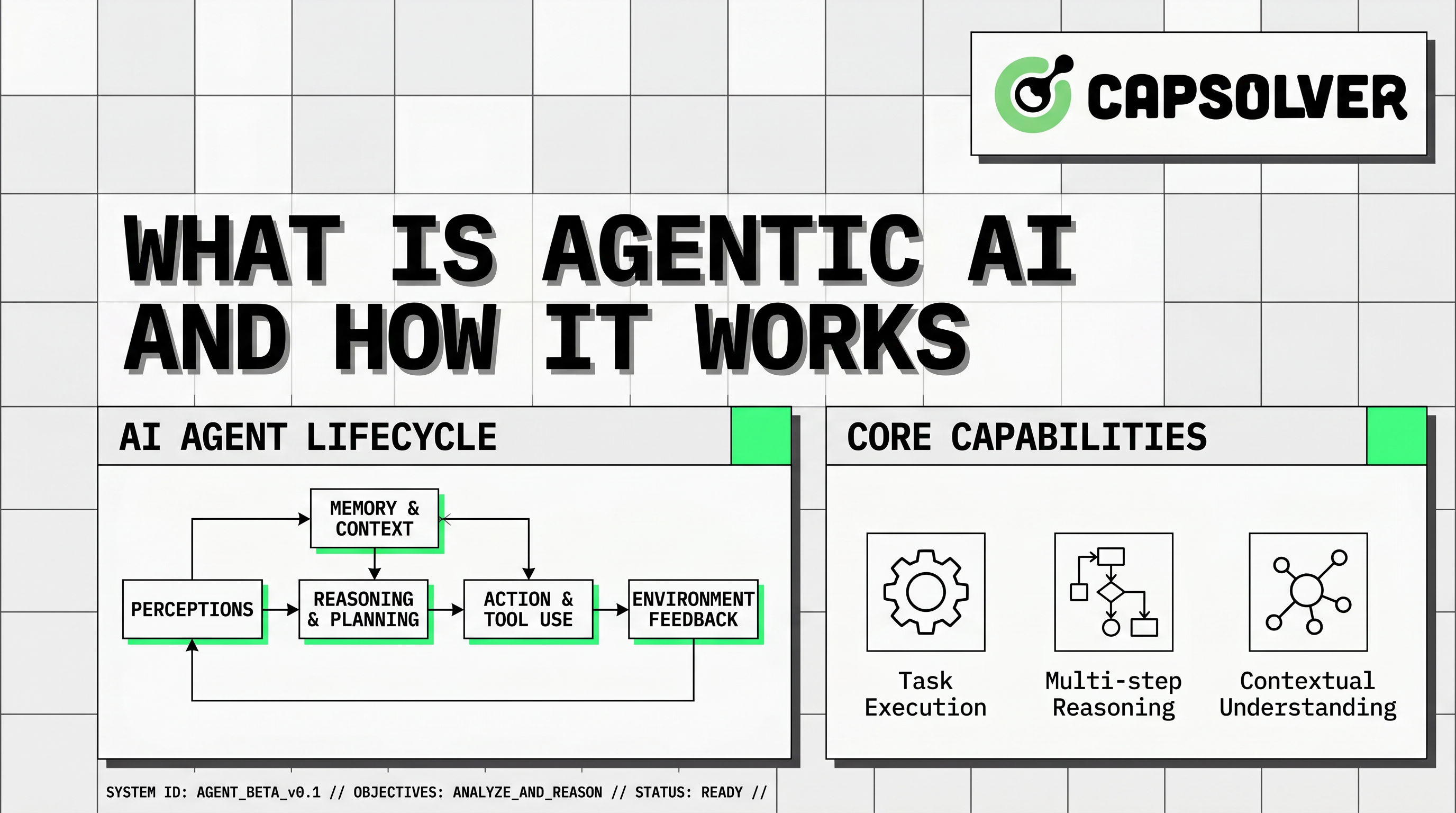
The landscape of artificial intelligence is undergoing a profound transformation. We are moving beyond systems that merely generate text or analyze data toward systems that take autonomous action. This shift brings us to the forefront of agentic AI. But what is agentic AI, and why is it becoming the cornerstone of modern digital operations? For developers, data engineers, and business leaders, understanding this technology is no longer optional—it is essential for maintaining a competitive edge. This article explores the core concepts of agentic AI, its practical applications in automated web interaction, and how to navigate the inevitable challenges of web security mechanisms like CAPTCHAs to ensure smooth, efficient automation.
To grasp the significance of agentic AI, we must first understand its foundational principles. While traditional AI models excel at specific, narrow tasks—such as predicting outcomes or generating content based on prompts—agentic AI represents a leap toward autonomy.
At its core, agentic AI describes systems designed to operate with a defined objective, making structured decisions and executing actions independently to achieve that goal. According to MIT Sloan, these are autonomous software systems that perceive, reason, and act in digital environments. They possess the capability to use external tools, engage in economic transactions, and interact strategically.
Unlike generative AI, which waits for human instruction, an AI agent can initiate processes. It interprets intent, evaluates available options, and executes a sequence of actions. This transition marks a shift from AI as a reactive tool to AI as a proactive collaborator.
The mechanics of agentic AI rely on a sophisticated blend of technologies. It builds upon the probabilistic nature of Large Language Models (LLMs) for reasoning and understanding, while integrating deterministic components for reliable execution.
The workflow of an AI agent typically involves:
AI agents exist on a spectrum of complexity, tailored to different operational needs:
The theoretical capabilities of agentic AI translate into powerful real-world applications, particularly in the realm of automated web interaction. By simulating human browsing behavior, these agents can navigate the complexities of the modern internet.
Traditional web scraping often relies on rigid scripts that break when a website's layout changes. Agentic AI brings adaptability to data extraction. An AI agent can visually analyze a webpage, identify the relevant data points regardless of structural shifts, and extract the information accurately. This is invaluable for market research, competitive analysis, and financial forecasting. For those building robust data pipelines, understanding Web Scraping Anti-Detection Techniques is critical to maintaining stability.
In the retail sector, agentic AI powers dynamic pricing engines and automated inventory management. Agents continuously monitor competitor websites, analyze market trends, and adjust pricing strategies in real-time. Furthermore, they can automate the purchasing process for supply chain replenishment, interacting with vendor portals autonomously.
Customer service is being revolutionized by agents that go beyond simple chatbots. An agentic system can receive a customer complaint, access the CRM to review the user's history, interact with the shipping provider's API to track a package, and issue a refund—all without human intervention. Workday highlights that these systems are highly suited for business challenges requiring flexibility and initiative, such as reallocating resources based on unexpected demand.
While agentic AI offers immense potential, its operation in the wild internet is not without friction. As agents automate web interactions, they inevitably trigger anti-bot security measures designed to differentiate between human users and automated scripts.
CAPTCHAs (Completely Automated Public Turing test to tell Computers and Humans Apart) are the primary defense mechanism deployed by websites. They come in various forms, from simple text recognition to complex image puzzles and behavioral analysis (like reCAPTCHA v3 or Cloudflare Turnstile).
When an AI agent encounters a CAPTCHA, its automated workflow is halted. The agent must either solve the challenge or fail the task. This presents a significant bottleneck for scalable web automation.
Modern anti-bot systems do not rely solely on visual puzzles. They employ sophisticated risk control mechanisms that analyze:
To maintain seamless automated web interaction, AI agents must be equipped to handle these security layers effectively. This requires integrating specialized solutions into the automation architecture.
To highlight the advancement, let's compare traditional automation methods with agentic AI approaches in web interaction.
| Feature | Traditional Automation (Scripts) | Agentic AI |
|---|---|---|
| Adaptability | Low. Breaks easily if website structure changes. | High. Adapts to layout changes and dynamic content. |
| Decision Making | Rule-based (If/Then logic). | Autonomous reasoning and planning. |
| Error Handling | Fails upon encountering unexpected errors. | Can assess errors and attempt alternative solutions. |
| Tool Integration | Hardcoded API calls. | Dynamic tool selection and usage. |
| Complexity | Best for simple, repetitive tasks. | Capable of complex, multi-step workflows. |
For agentic AI to fulfill its promise in automated web interaction, it requires reliable infrastructure to overcome security hurdles. This is where CapSolver becomes an indispensable component of the automation stack.
CapSolver provides a robust, AI-powered CAPTCHA solving service designed to integrate seamlessly into automated workflows. By handling the complex task of bypassing anti-bot mechanisms, CapSolver allows your AI agents to focus on their primary objectives.
Redeem Your CapSolver Bonus Code
Boost your automation budget instantly!
Use bonus code CAP26 when topping up your CapSolver account to get an extra 5% bonus on every recharge — with no limits.
Redeem it now in your CapSolver Dashboard
When building agentic systems for web interaction, integrating CapSolver offers several key advantages:
Integrating CapSolver into an agentic AI workflow typically involves API calls. When the agent detects a CAPTCHA, it sends the necessary parameters (such as the website URL and site key) to the CapSolver API. CapSolver processes the request and returns a token, which the agent then submits to the target website to bypass the security check.
For teams utilizing low-code automation platforms, CapSolver also integrates smoothly. You can learn How to Use CapSolver in n8n to build reliable automation workflows without extensive coding.
By ensuring that your AI agents can reliably navigate CAPTCHAs, you unlock the full potential of automated web interaction, driving efficiency and innovation in your operations.
Agentic AI represents a paradigm shift in how we approach automated web interaction. By moving from rigid scripts to autonomous, reasoning systems, businesses can execute complex workflows, adapt to dynamic environments, and extract value from the web at an unprecedented scale. As Harvard Business Review notes, the way humans interact and collaborate with AI is taking a dramatic leap forward. However, realizing this potential requires addressing the realities of web security. By understanding the mechanics of agentic AI and leveraging specialized solutions like CapSolver to handle CAPTCHAs and anti-bot systems, organizations can build resilient, scalable, and highly effective automated operations.
1. What is the main difference between generative AI and agentic AI?
Generative AI primarily focuses on creating content (text, images, code) based on user prompts. Agentic AI, on the other hand, is designed to take autonomous action, make decisions, and execute multi-step plans to achieve a specific goal without constant human intervention.
2. Can agentic AI completely replace traditional web scraping tools?
While agentic AI offers superior adaptability and reasoning, traditional web scraping tools are still highly efficient for simple, structured data extraction tasks. Agentic AI is best deployed for complex scenarios where websites frequently change or require sophisticated interaction and decision-making.
3. How do AI agents handle CAPTCHAs during automated web interaction?
AI agents typically cannot solve complex CAPTCHAs natively. They rely on integrating third-party CAPTCHA solving services, like CapSolver, via API. The agent detects the CAPTCHA, sends the challenge to the service, receives a solution token, and submits it to proceed.
4. Is it legal to use AI agents for automated web interaction?
The legality depends on the specific use case, the target website's Terms of Service, and local data privacy laws. It is crucial to ensure that your automated interactions comply with ethical guidelines and legal requirements, avoiding malicious activities or overwhelming target servers.
Lucas Mitchell
Automation Engineer
Helping browser automation recover and continue.
ABOUT THE AUTHOR
Discover how AI agents transform web scraping and competitive intelligence. Learn about automated data collection, anti-bot challenges, and CAPTCHA solutions for scalable workflows.

Discover the key differences between AI agent vs chatbot. Learn how agentic AI outperforms traditional AI in automation, decision-making, and complex workflows.