🎉NEWCapSolver for AI agents-MCP, agent tools, and SDK integrations

Adélia Cruz
MCP Integration Engineer
Published Apr 03, 2026
Updated Apr 03, 2026 · min read
TL;Dr:
The digital landscape is increasingly defined by the tension between automated systems and security measures. CAPTCHAs, or "Completely Automated Public Turing tests to tell Computers and Humans Apart," serve as the primary gatekeepers against malicious bot activity. However, for legitimate businesses involved in data collection, price monitoring, or SEO auditing, these barriers can halt progress. Understanding the choice between CAPTCHA solving API vs manual solving is critical for optimizing operational efficiency. This article explores the fundamental differences, cost structures, and technical mechanisms of both approaches, helping you decide which solution aligns with your automation goals while maintaining compliance and reliability.
At its core, a CAPTCHA is a challenge-response test used in computing to determine whether the user is human. Since their inception, they have evolved from simple distorted text to complex image recognition and behavioral analysis. According to Wikipedia, the primary goal is to prevent automated software from performing actions that should be reserved for humans, such as creating thousands of fake accounts or scraping proprietary data.
Modern security systems like reCAPTCHA and Cloudflare Turnstile don't just look at the answer; they analyze mouse movements, IP reputation, and browser fingerprints. This complexity has led to the development of two distinct solving methodologies: manual human-in-the-loop systems and AI-powered APIs.
Manual solving involves a network of human workers who receive CAPTCHA challenges in real-time and solve them on behalf of the automated system.
When your bot encounters a challenge, it sends the image or site key to a service provider. This provider then displays the challenge to a human worker. Once the worker solves it, the answer is sent back to your bot.
A CAPTCHA solving API vs manual solving comparison highlights the shift toward machine learning. Modern APIs use advanced Optical Character Recognition (OCR) and neural networks to solve challenges without human intervention.
Services like CapSolver utilize deep learning models trained on millions of examples. When a request is made, the AI identifies the patterns—whether it's identifying traffic lights or solving a mathematical puzzle—and returns a token or solution in seconds. This process is documented extensively in the W3C's research on the inaccessibility of CAPTCHA, which notes that as AI improves, the gap between human and machine performance continues to shrink.
In web scraping automation, every second counts. An API can handle thousands of requests simultaneously, whereas manual solving is limited by the number of available workers. This scalability is why most enterprises prefer an automated captcha solver for their production environments.
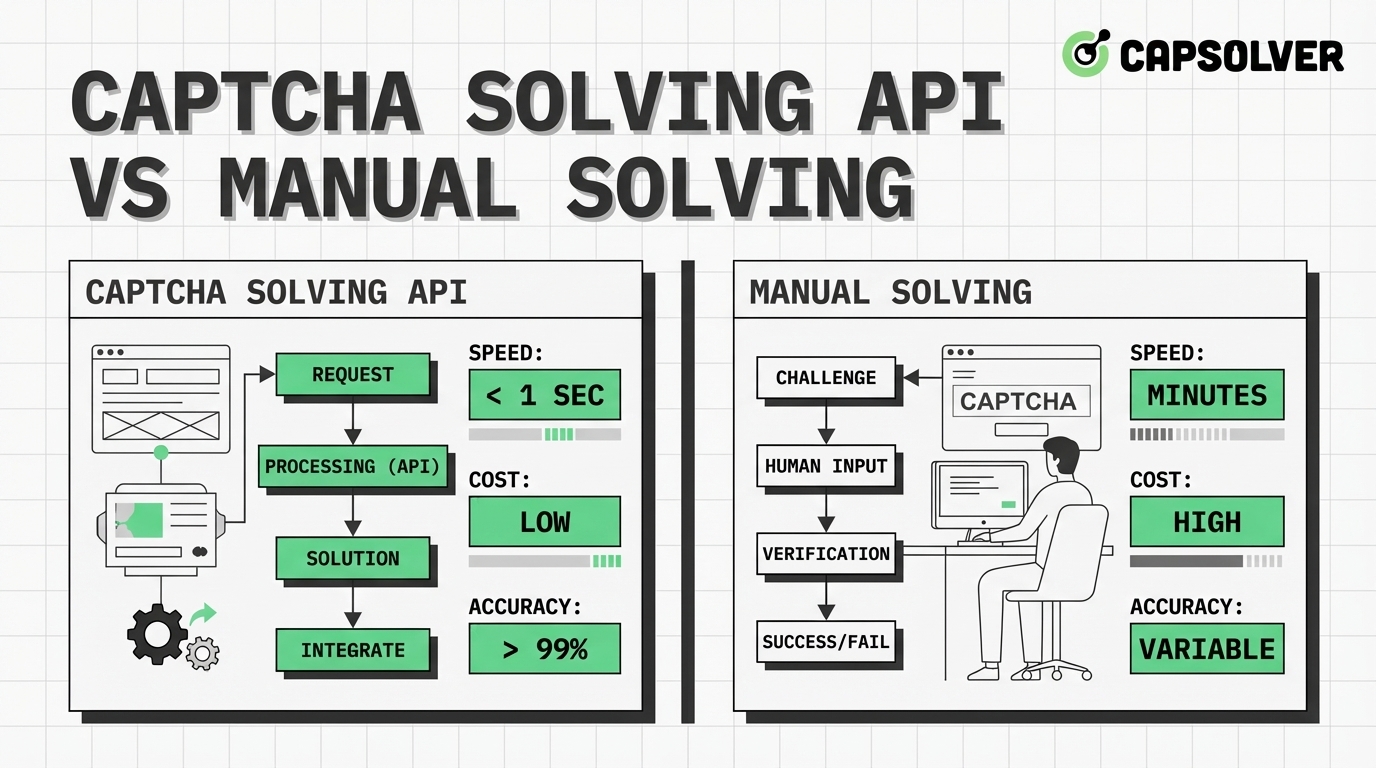
To better understand the trade-offs, let's look at a direct comparison of the two methods.
| Feature | Manual Solving | CAPTCHA Solving API |
|---|---|---|
| Speed | Slow (10–30 seconds) | Fast (1–5 seconds) |
| Scalability | Limited by human workforce | Virtually unlimited |
| Cost | High (Pay per worker time) | Low (Pay per 1,000 solves) |
| Accuracy | 99% (Human error exists) | 95%–99% (AI-dependent) |
| Integration | Moderate | Easy (REST API / SDKs) |
| Reliability | High for complex tasks | High for standard tasks |
When evaluating captcha solving cost, the difference is staggering. Manual services often charge based on the time taken or a higher flat rate per solve because they must pay the human workers. In contrast, an API-based captcha recognition service like CapSolver operates on a Cost Per Mille (CPM) model.
For example, solving 1,000 reCAPTCHA v2 challenges manually might cost $1.00 to $3.00, whereas an AI-powered API can do the same for as little as $0.10 to $0.60. For a business running millions of requests monthly, this represents a cost saving of over 80%.
Security providers are not static. They constantly update their "risk scores" to detect automation. A common reason why web automation keeps failing on captcha is the use of low-quality proxies or outdated solving methods.
Modern anti-bot systems analyze:
Using a sophisticated API allows you to integrate these factors into the solving process, ensuring that the returned solution is not just "correct" but also "trusted" by the target site.
For those looking to choose the best captcha solving API, CapSolver stands out as a leader in the field. By focusing on AI-driven solutions, it eliminates the latency associated with human workers while maintaining industry-leading accuracy.
Whether you are dealing with reCAPTCHA v2 or more complex challenges, CapSolver provides a seamless integration path. Their infrastructure is designed for high-concurrency environments, making it the best captcha solver for developers who need reliability and speed.
Use code
CAP26when signing up at CapSolver to receive bonus credits!
Integrating an API is straightforward. Below is a standard implementation using Python, as referenced in the CapSolver official documentation. This script demonstrates how to create a task and retrieve the result programmatically.
import requests
import time

# CapSolver API configuration
api_key = "YOUR_API_KEY"
site_key = "6Le-wvkSAAAAAPBMRTvw0Q4Muexq9bi0DJwx_mJ-"
site_url = "https://www.google.com/recaptcha/api2/demo"

def solve_captcha():
    payload = {
        "clientKey": api_key,
        "task": {
            "type": 'ReCaptchaV2TaskProxyLess',
            "websiteKey": site_key,
            "websiteURL": site_url
        }
    }
    # Create the task
    res = requests.post("https://api.capsolver.com/createTask", json=payload)
    task_id = res.json().get("taskId")

    if not task_id:
        print("Failed to create task")
        return None

    # Poll for the result
    while True:
        time.sleep(1)
        result_payload = {"clientKey": api_key, "taskId": task_id}
        result_res = requests.post("https://api.capsolver.com/getTaskResult", json=result_payload)
        result_json = result_res.json()

        if result_json.get("status") == "ready":
            return result_json.get("solution", {}).get('gRecaptchaResponse')
        if result_json.get("status") == "failed":
return NoneIt is essential to emphasize that using a CAPTCHA solving API vs manual solving should always be done within the bounds of legal and ethical guidelines. Automation should respect the Terms of Service of target websites and be used for legitimate purposes such as academic research, market analysis, or personal productivity. According to Cloudflare, the goal of security is to stop "bad bots," not to hinder legitimate innovation.
The debate between CAPTCHA solving API vs manual solving is largely settled by the needs of the modern web. While manual solving offers a niche for highly irregular challenges, the speed, cost-effectiveness, and scalability of APIs make them the superior choice for 99% of use cases. By leveraging AI-powered services like CapSolver, businesses can overcome technical hurdles and focus on what truly matters: gathering insights and driving growth.
Yes, using these services is generally legal for legitimate purposes like web scraping or testing. However, you must always comply with the laws of your jurisdiction and the terms of service of the websites you interact with.
Most users see a cost reduction of 70% to 90%. APIs are significantly cheaper because they do not require paying for human labor per solve.
Modern APIs can solve the vast majority of common CAPTCHAs, including reCAPTCHA, Cloudflare, and image-based puzzles. Only extremely rare or custom-built challenges might still require human intervention.
A high-quality API like CapSolver typically returns a solution in 1 to 10 seconds, depending on the complexity of the challenge.
While many APIs offer "proxyless" options, using your own high-quality proxies is often recommended for better reliability and to avoid IP-based blocks from the target website.
Adélia Cruz
MCP Integration Engineer
Making CapSolver tools accessible through MCP.
ABOUT THE AUTHOR
Explore how AI detects and solves CAPTCHA challenges, from image recognition to behavioral analysis. Understand the technology behind AI CAPTCHA solvers and how CapSolver aids automated workflows. Learn about the evolving battle between AI and human verification.

Compare top CAPTCHA solving APIs by speed, accuracy, uptime, and pricing. See how CapSolver, 2Captcha, CapMonster Cloud, and others stack up in our detailed performance comparison.